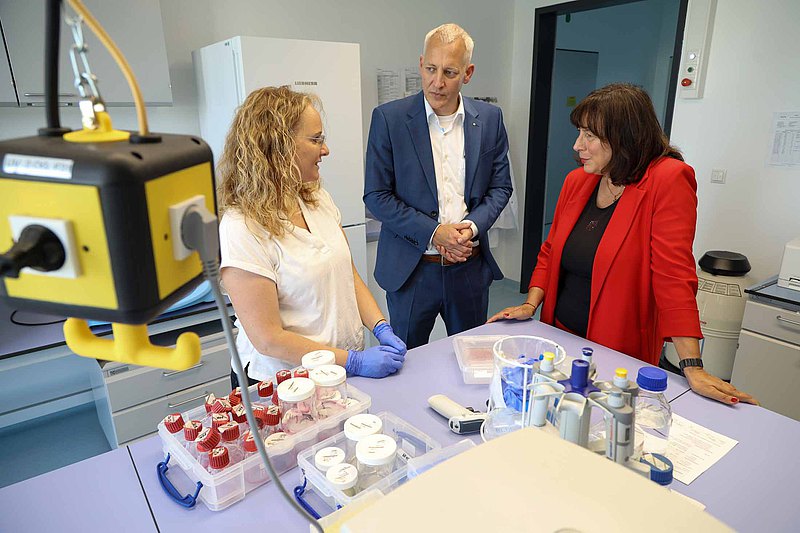
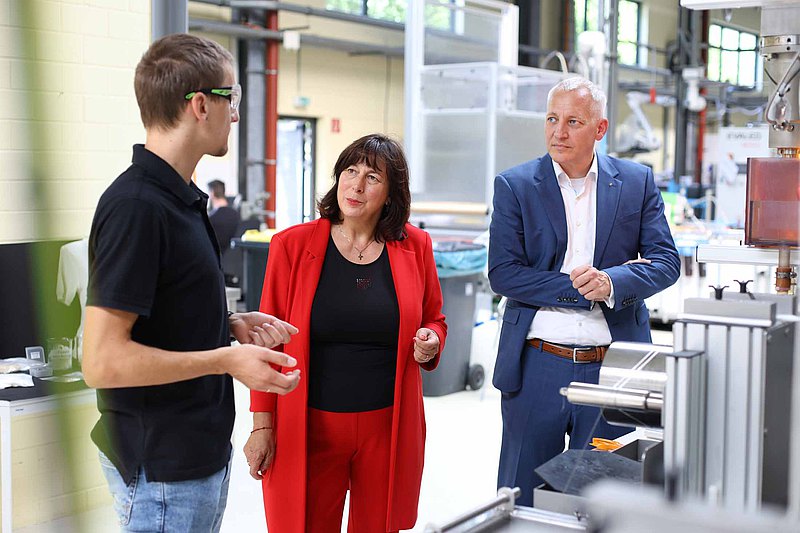
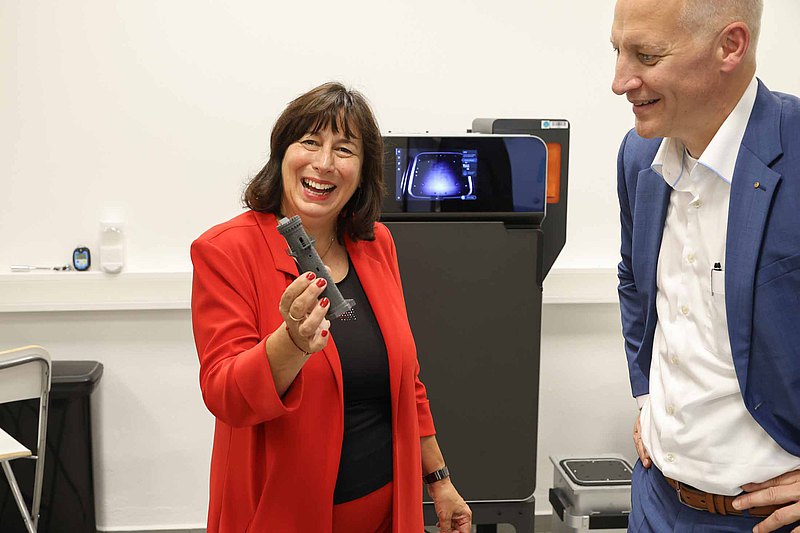
On September 4, 2026, Member of the European Parliament Marion Walsmann (EPP Group) visited the Thuringian Institute for Textile and Plastics Research (TITK) in Rudolstadt and held in-depth discussions with TITK Director Benjamin Redlingshöfer about current research priorities and the political framework.
Rudolstadt – Bringing innovation to market is the core mission of industry-oriented research. And it is vital for all industry-oriented research institutes in Thuringia that do not receive core funding, Redlingshöfer said. However, this cannot be achieved through project funding alone. Therefore, it is imperative that 30 to 50 percent of funding be generated through collaboration with industry. In this regard, the TITK ranks at the top among industry-oriented research institutions. Redlingshöfer emphasized that this is not a judgment on other major research institutions, but rather a statement of position: “The institutes of the Thuringia Research and Technology Network (FTVT) operate very closely with industry and are the institutions with the strongest technology transfer capabilities in Germany.”
To ensure this continues to work in the future, stable framework conditions for project funding are needed. The INNO-KOM program must retain its proven funding structure. “The institutes of the Zuse-Gemeinschaft manage just fine with funding well below 100 percent. They organize complementary direct research contracts from industry and, at the same time, relieve companies of a considerable amount of bureaucratic burden,” said Redlingshöfer. In contrast, the frequent changes to the ZIM program - most recently the deadline for applications on July 7, 2026 - are causing confusion among both SMEs and research institutions. This shift in direction is all the more puzzling given that the Conference of Economic Ministers had only recently set different priorities and had at least advocated for inflation adjustments to the funding budgets.
“A good tool that needs further development”
Redlingshöfer also noted that the tax research credit is, in principle, a good tool. However, he said, it needs to be further developed, as the current assessment criteria disproportionately favor large companies. The Zuse-Gemeinschaft has already presented a position paper on this topic with specific proposals for changes - which is of interest to Marion Walsmann, who, given Thuringia’s business landscape dominated by SMEs, intends to advocate for the further development of this funding instrument.
Redlingshöfer also promoted the “Get started 2gether” startup program established in Thuringia. To date, 79 startup projects have benefited from it. The funding rate is good, and the timeline - which is crucial for entrepreneurs - is virtually unparalleled: collaborations with suitable research institutions can begin after just six to eight weeks. As chairman of the organizing Thuringia Research and Technology Network, he expressly invited Marion Walsmann to attend the next pitch event in spring 2027 at the Eiermannbau in Apolda.
The discussion then turned to specific innovations from the TITK - ranging from the diverse Lyocell functional fibers of the Cell Solution® family to sustainable vehicle underbodies and biodegradable plant containers for forestry, all the way to the recycling and reuse of carbon fiber waste. The TITK’s newest initiative, the Innovation Center for Textile Circular Economy (DICE), was also presented. Redlingshöfer summed up a key principle: “Every sustainability effort must ultimately be ecologically and economically viable.”
Marion Walsmann referred, among other things, to her EU initiative to classify sheep’s wool no longer as waste but as a valuable, sustainable resource. She noted that she has received support for this initiative from Ireland and Romania, among others.
And - she wanted to know - how does Thuringia’s industry-oriented research compare to that of other federal states? “We’re right at the forefront when it comes to the speed of implementation,” Redlingshöfer replied. Short decision-making paths and innovative solutions for a wide variety of industries are key factors in this regard. His conclusion, with a wink: “We may not be building the rocket that flies to Mars here in Thuringia. But someone has to develop the screws for the rocket, too.” In that respect, he said, it makes sense to occupy attractive niche markets, which often promise better profit margins.